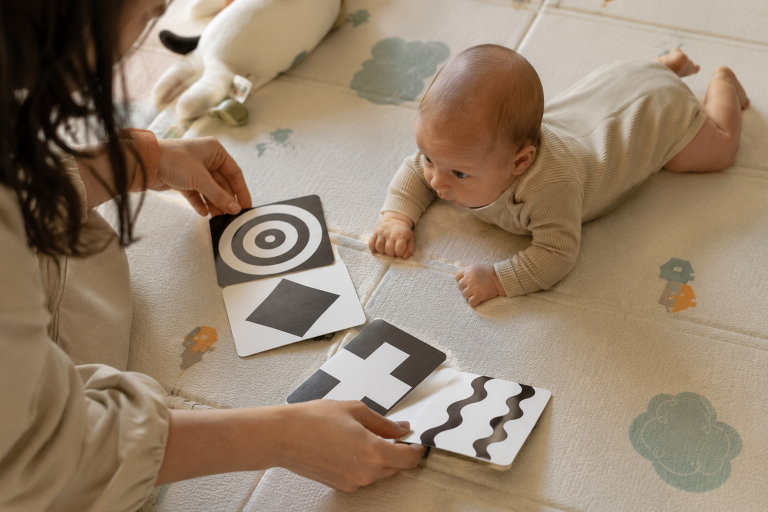
High Contrast Images for Babies: Why Newborns Love Black & White
- Created:
18. 8. 2026 - Updated:
26. 8. 2026 -


Your newborn may ignore the colorful toys you carefully picked out—and stare at a simple black-and-white pattern instead.
It might not look very exciting to you, but to your baby, that bold contrast can be fascinating.
A newborn’s vision is still developing, which means simple shapes and strong differences between light and dark are often easier to notice than soft colors or detailed pictures. That’s why high contrast images for babies are so popular during the first few months.
But what exactly are high contrast images? When should you start using them? And how can you make them part of tummy time and everyday play?
Here’s what parents need to know.
What Are High Contrast Images for Babies?
High contrast images are simple pictures made with strongly contrasting colors.
For newborns, this usually means black and white.
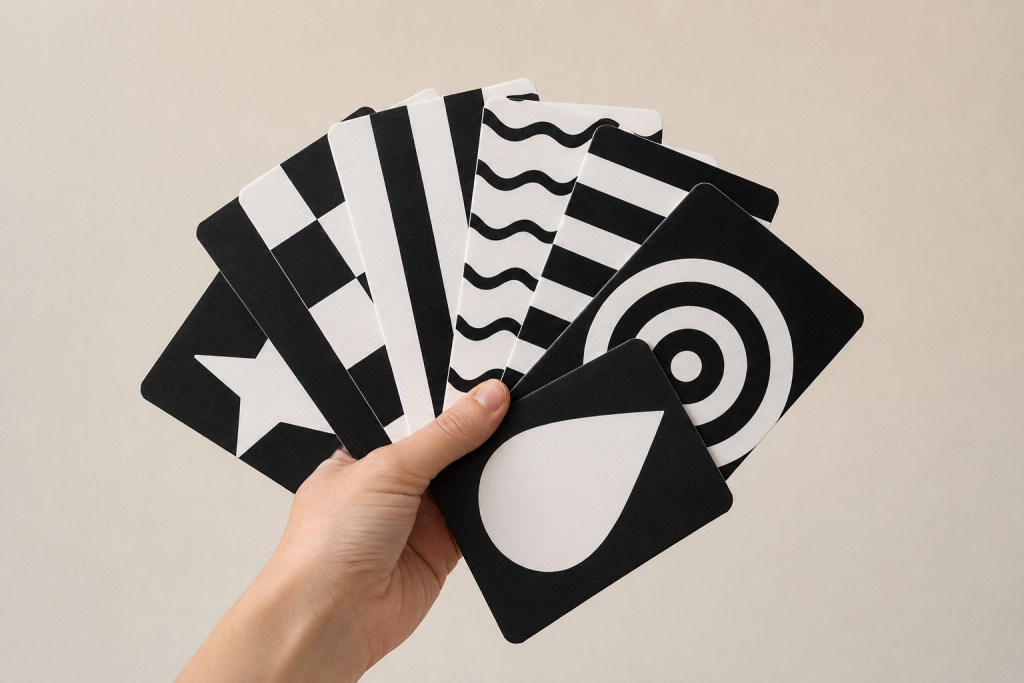
Instead of detailed illustrations, high contrast baby images typically feature:
- stripes,
- circles,
- checkerboards,
- spirals,
- simple faces,
- geometric shapes,
- animals,
- stars,
- leaves,
- and other bold patterns.
The idea is simple: clear shapes with strong contrast are easier for developing eyes to notice.
As your baby gets older, high contrast images can gradually include more colors and more detailed patterns.
Why Do Babies Like High Contrast Images?
Your baby can see from birth, but newborn vision is very different from adult vision.
During the first weeks of life, babies are still learning how to focus their eyes, follow objects, and process everything they see around them.
That bright pastel nursery may look beautiful to you, but subtle shades and tiny details aren’t necessarily the easiest things for a newborn to notice.
Bold black-and-white patterns stand out much more clearly.
This is one reason newborns may seem especially interested in:
- your face,
- dark shapes against a light background,
- striped clothing,
- window frames,
- shadows,
- or simple black-and-white pictures.
High contrast cards simply give babies another interesting object to look at while their visual skills continue to develop.
And they don’t need to become a serious developmental exercise.
Think of them as another simple way to play, interact, and spend awake time together.
When Should You Start Showing High Contrast Images to Your Baby?
You can introduce high contrast images from the newborn stage.
How you use them can change as your baby’s vision and attention develop.
Newborn to 2 Months
During the earliest weeks, keep things simple.
Choose large black-and-white shapes rather than complicated illustrations and show your baby one or two images at a time.
You can place a card near your baby during supervised awake time or hold it where they can comfortably see it.
Don’t worry if your newborn only looks at the image briefly.
At this age, even a few moments of attention can be plenty.
Around 2 to 4 Months
As your baby becomes more alert, you may notice them spending longer looking at patterns, faces, toys, and other objects.
This can be a good time to introduce:
- slightly more detailed patterns,
- different shapes,
- simple pictures of animals,
- faces,
- and additional bold colors.
You can also begin using the cards for gentle visual tracking by slowly moving an image from one side to the other and seeing whether your baby follows it with their eyes.
Keep the movement slow and let your baby lead the activity.
Around 4 to 6 Months
By this stage, your baby’s visual world is becoming much richer.
Bright toys, colorful books, faces, movement, and objects around the room may all become increasingly interesting.
You don’t necessarily need to stop using high contrast cards.
Instead, make them one part of a wider variety of visual experiences.
Your baby’s favorite activity might soon change from staring at a black-and-white spiral to trying very hard to grab it.

Sign up to our newsletter
get weekly access to our best deals, tips and tricks.
What Are the Best High Contrast Images for Babies?
You don’t need complicated illustrations to catch a baby’s attention.
In fact, simple designs are often exactly what you want.
Some popular high contrast patterns for babies include:
Faces
Babies are naturally interested in faces.
Simple illustrations with large eyes, mouths, and clearly defined features can make engaging high contrast cards.
Stripes
Horizontal, vertical, diagonal, thick, thin—there are plenty of variations.
Strong black-and-white stripes create an obvious visual difference that’s easy to notice.
Circles and Dots
Large dots and repeating circles are simple but visually interesting.
Try patterns with different sizes and arrangements.
Spirals
A bold spiral provides a clear shape that naturally draws the eye toward the center.
Checkerboards
Alternating black-and-white squares create one of the strongest and simplest contrast patterns.
Animals
Once your baby becomes more interested in recognizable pictures, simple black-and-white illustrations of animals can add variety.
Think butterflies, cats, bears, fish, birds, or other familiar shapes.
Nature-Inspired Shapes
Leaves, flowers, clouds, moons, and stars can all be simplified into bold high contrast designs.
The specific picture isn’t the most important part.
What matters most is keeping the design clear, bold, and easy to look at.
Printable High Contrast Cards for Babies
If you’d rather skip searching for individual pictures and have a ready-to-use collection, printable high contrast cardscan make things much easier.
We’ve prepared printable cards; you’ll receive a digital PDF file you can print at home or through a local printing service.
For cards you’ll use regularly, consider printing them on thicker paper or cardstock. You can also laminate them to make them more durable and easier to reuse.
Keep a few near the changing table, add some to your baby’s play area, or rotate different cards during tummy time.
Looking for a set that’s ready to print?
Explore our printable high contrast baby cards on Etsy →
Simply download the PDF file, print the cards, and they’re ready for your baby’s next awake-time adventure.
5 Easy Ways to Use High Contrast Images With Your Baby
You don’t need to schedule special “high contrast time.”
Instead, cards can easily become part of activities you’re already doing with your baby.
1. Add Them to Tummy Time
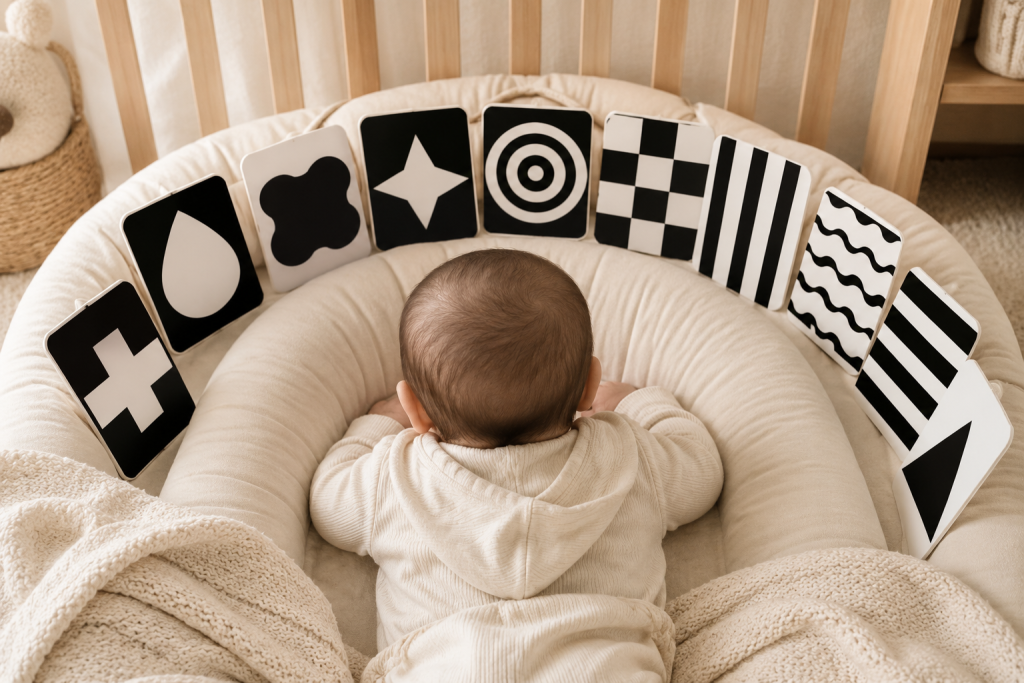
Tummy time is one of the easiest opportunities to introduce a high contrast card.
Place one in front of your baby while they’re awake and supervised.
The picture gives them something interesting to look toward while they spend time on their tummy.
Try switching cards occasionally so there is something new to discover.
2. Use Them During Diaper Changes
Diaper changes happen many times a day, especially with a newborn.
Placing a high contrast image near the changing area can give your baby something interesting to look at while you’re busy with the practical part.
Just make sure anything placed nearby is safely out of reach.
3. Include Them in Quiet Play
Sometimes the simplest activity is enough.
Sit with your baby and show them one image at a time.
Talk about what they are looking at:
“Look at those big circles.”
“Can you see the little bear?”
Your baby won’t understand every word yet, of course, but they’re getting something even more valuable—the sound of your voice and your attention.
4. Practice Following an Image
When your baby is alert and interested, hold a card where they can see it.
Then slowly move it a little to one side.
Pause.
Move it gently toward the other side.
Your baby may begin following the image with their eyes or turning their head toward it.
If they look away, that’s okay. You can always try again another time.
5. Use High Contrast Books and Cards Together
You don’t have to choose between flashcards and books.
A high contrast baby book can become part of your reading routine, while individual cards are convenient for tummy time, playtime, or taking along in the stroller or diaper bag.
The most important part isn’t the format.
It’s the interaction happening between you and your baby.
How Long Should Babies Look at High Contrast Images?
There is no perfect number of minutes your baby needs to spend looking at high contrast cards.
And there’s no need to turn them into another item on your parenting checklist.
Some babies may stare at a picture for quite a while. Others may glance at it and immediately become interested in something else.
Follow your baby’s cues. If your baby:
- looks away repeatedly,
- becomes fussy,
- closes their eyes,
- or simply seems uninterested,
the activity is probably finished for now.
You can try again later.
High contrast cards should feel like play—not homework.
Are High Contrast Images Necessary for Babies?
No.
You don’t need high contrast cards for your baby to develop normally.
Babies already experience contrast throughout everyday life—from faces and shadows to clothing, furniture, books, windows, and the world around them.
High contrast images are simply another age-appropriate way to make playtime interesting.
And you certainly don’t need to spend every waking minute trying to “stimulate” your newborn.
Looking at your face, listening to your voice, cuddling, feeding, moving around, and exploring their surroundings already give your baby plenty to process.
High contrast cards can complement those everyday experiences rather than replace them.
High Contrast Images for Babies: What to Remember
Your newborn doesn’t need complicated toys to find the world interesting.
Sometimes a few black lines on a white background are enough.
During the first months, high contrast images for babies can provide simple visual interest while your baby’s eyesight continues to develop.
Start with bold black-and-white patterns, use them during relaxed awake time, and gradually introduce different colors and images as your baby grows.
Most importantly, follow your baby’s lead.
If they’re fascinated by a card, let them look.
If they’d rather look at your face instead?
That’s a pretty good view, too.
Frequently Asked Questions
High contrast images can be an age-appropriate form of visual play for newborns and young babies. Bold differences between light and dark are easier for developing eyes to notice than subtle colors and detailed patterns.
You can introduce high contrast images from birth. Black-and-white patterns are particularly useful during the early months, while older babies can gradually explore more complex patterns and colors as their vision develops.
A newborn’s vision is still developing. Strong contrast between black and white creates clear visual boundaries that can be easier for young babies to notice than similar or muted colors.
You don’t have to wait to show your baby colorful objects—babies are surrounded by color from birth. As their vision develops over the first several months, they become increasingly interested in and capable of distinguishing a wider range of colors. You can gradually mix colorful books, toys, and pictures with your black-and-white cards.
Every baby develops at their own pace. If you have concerns about your baby’s eyesight, eye movements, or visual development, speak with your pediatrician or another qualified healthcare professional.


